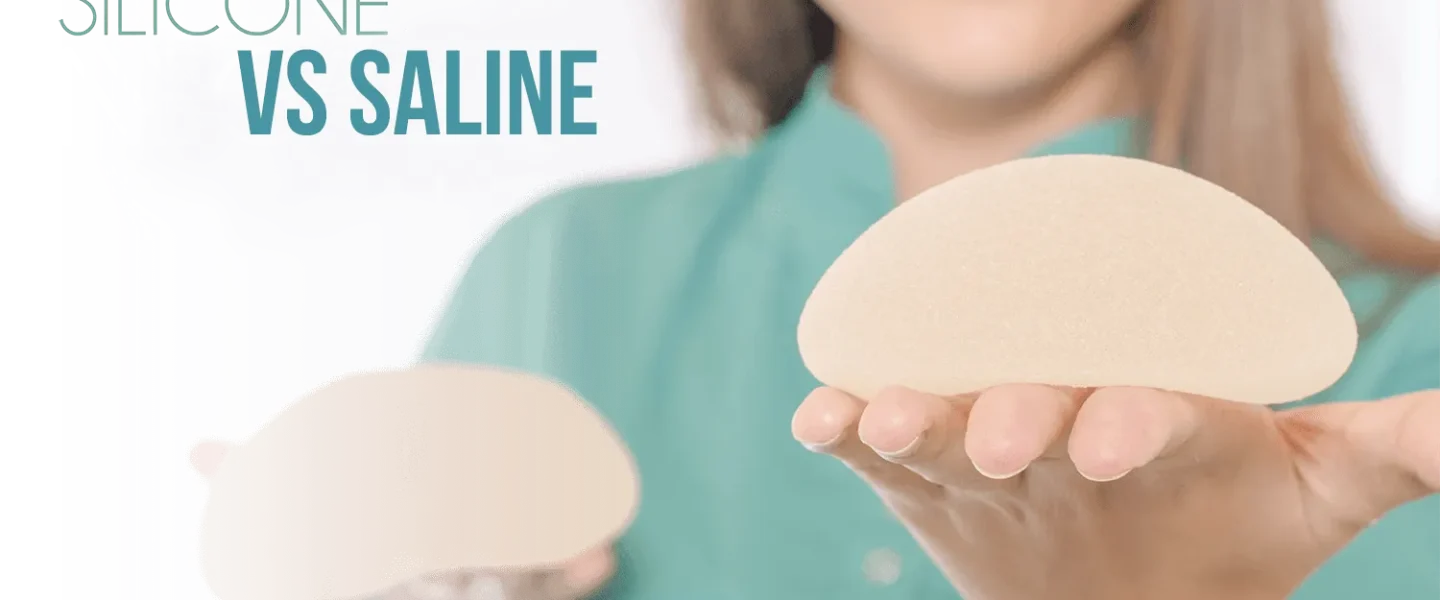
Breast implants add volume to existing breast tissue to create a fuller chest during a breast augmentation. Women considering this procedure often ask, “What’s the difference between saline and silicone implants? And which is right for me?”
Patients are often surprised to learn both saline and silicone implants have an outer silicone shell, yet differ in material and consistency. Silicone implants are sometimes superior, especially since the introduction of the new generation “gummy” silicone implants. Dr. Ashley Robey notes, “I am sure this is different from practice to practice, but would guesstimate about 70% of my clients choose silicone and about 30% choose saline. Worldwide, those numbers are skewed even more choosing silicone.”
Saline implants are filled with sterile salt water; they are inserted empty and then filled to a previously-agreed upon volume. Silicone implants are prefilled with silicone gel (like a gumdrop or gummy bear consistency), which more closely mimics the feel of human breast tissue. Most women think that silicone breast implants look and feel more like natural breast tissue.
“All implants, regardless of type, are not considered to be lifetime devices,” says Robey. “You can think about the wear patterns that you see on the bottom of your shoes after walking around for a few months – it’s the same phenomenon with implants except the wear and material stress occurs with breathing, chest movements and arm movements.”
If an implant ruptures, the approach might vary depending on whether the implant is saline or silicone. If a saline breast implant ruptures, the implant will deflate, causing the affected breast to change in size and shape. The leaking saline solution will be absorbed by your body without posing any health risks, but you’ll probably need surgery to remove the silicone shell.
If a silicone breast implant ruptures, you might not notice right away, or at all, because the form-stable silicone gel sticks to itself very well and tends to be well contained within the implant capsule, which is natural tissue that forms around the implant. A ruptured silicone gel implant isn’t believed to cause systemic or long-term health problems; it could, however, cause a change in the feel or contour of the breast. If this happens, you may likely need surgical removal of the implant.
Other implant options also include rounded or shaped, and textured or smooth, all of which come in a variety of sizes. Your best route is to schedule an initial consultation with Dr. Robey, who will discuss all these options with you, taking into account your body type and goals.


NIPPED & TOXXED Podcast: Mic Check!
Real Talk on Plastic Surgery, Aesthetics & Regenerative Medicine
Ever wondered what actually happens behind the scenes of plastic surgery and aesthetics? Dr. Ashley Robey is here to spill the tea! From the latest beauty treatments to the science of aging gracefully, she breaks it all down—no fluff, no filters, just real talk. Whether you’re thinking about a little enhancement, a major transformation, or just want to stay in the know, this is the podcast for you.
Listen: